Duo AI
Client
Personal Project
Year
2025 – Present
Services
Product Design
AI
Conversational UX
Context & Challenge
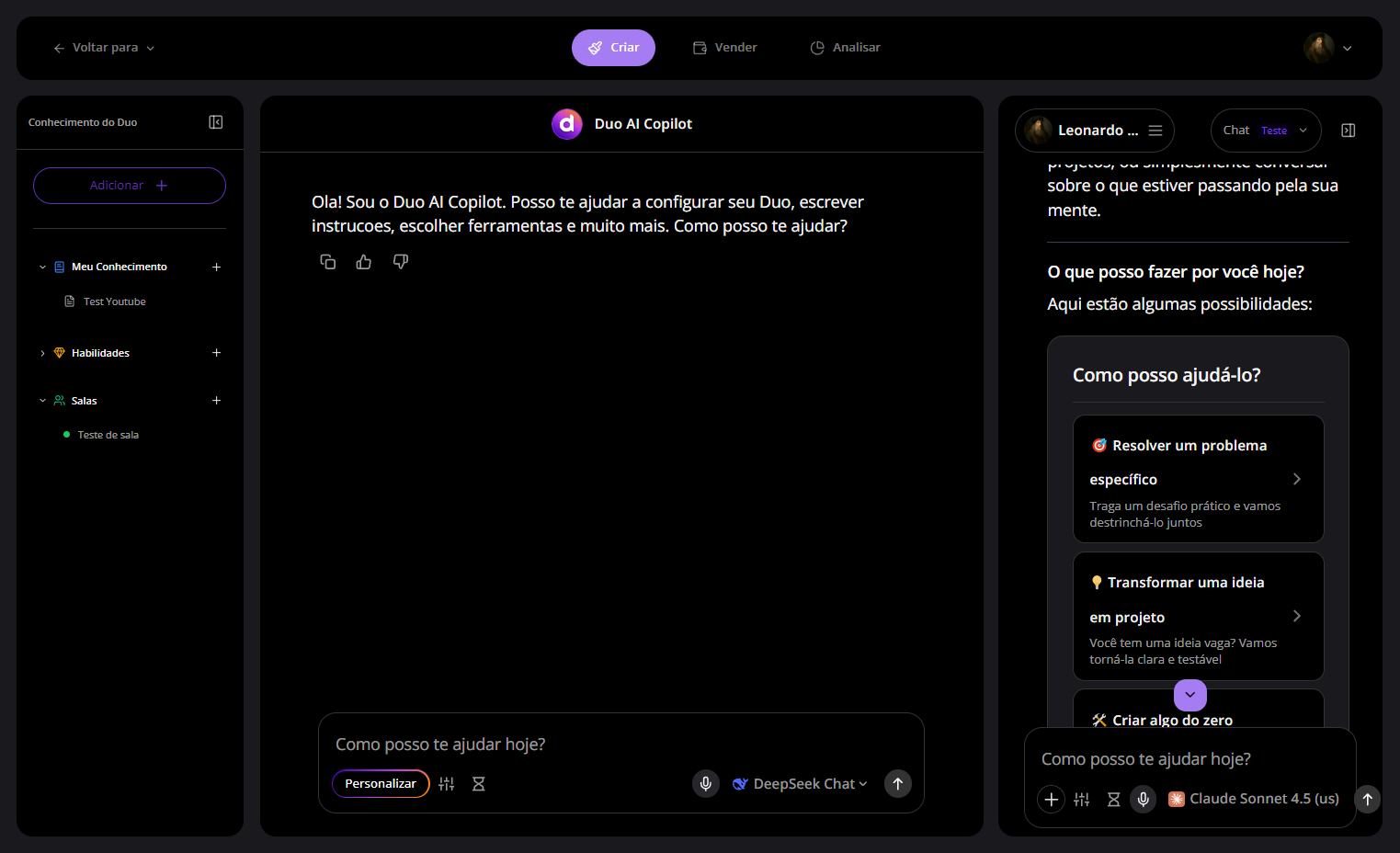
Duo AI is a conversational AI platform with two sides: the Studio, where creators build custom assistants (choosing model, instructions, knowledge base, tools), and the chat, where end-users interact with those assistants.
The core challenge: configuring an AI assistant involves dozens of technical decisions (model, temperature, tools, knowledge base). How do you make that accessible to someone who's never written a prompt — without limiting power users who want full control?
My Role
Founding designer responsible for the product end-to-end. I designed the Studio architecture (creation panel, conversational onboarding, real-time preview), the chat experience, and the interaction patterns between creator and end-user.
Process
I started by benchmarking existing platforms — ChatGPT, Claude, Perplexity, Gemini, Custom GPTs — mapping how each handles assistant creation and where the gaps were.
From there, I separated the product into two distinct flows: the creator flow (Studio) and the end-user flow (chat). Each has completely different needs and mental models.
For the Studio, I designed a conversational onboarding — instead of a form with 15 fields, the assistant itself guides the creator through configuration via a conversation. The creator "talks" to their assistant to set it up.
I prototyped and tested with users ranging from technical (devs already using APIs) to non-technical (consultants who want an assistant to serve their clients).
Key Decisions
Conversational onboarding in Studio
instead of a traditional form, the creator configures their assistant by talking to it. This reduces the intimidation of technical fields and lets the assistant suggest settings based on the context the creator describes.
Real-time preview
as the creator adjusts instructions, model, or knowledge base, a side panel shows exactly how the assistant will behave. No "save and test" — feedback is immediate.
Two products in one, two mental models
the creator thinks about configuration, control, customization. The end-user thinks about conversation, answers, utility. The Studio interface can't "leak" into the chat — each side needs to be simple in its own context.
Progressive disclosure in the configuration panel
the Copilot Panel shows the essentials (name, instruction, model) first. Advanced tools (power-ups, rooms, API keys) surface as the creator needs them — without hiding, without overwhelming.
Results
Functional product with active users creating and using assistants
Studio with conversational onboarding that lowers the barrier for non-technical creators
Real-time preview that speeds up the creator's iteration cycle
Multi-model integration with consistent UX layer
Interface architecture that cleanly separates the creator side from the end-user side